Knicks Title Defense: Can New York Repeat After the 2026 Finals?
The Knicks title defense is credible, but history and roster economics make a repeat harder than the banner ceremony suggested. New York won the 2026 NBA Finals in five games, yet no champion since the 2017 and 2018 Warriors has repeated. Mitchell Robinson’s departure also removed a proven center after ownership reportedly refused to cross the second apron to preserve the championship group.
Why the Knicks title defense starts with a warning
New York earned its position. The Knicks beat the San Antonio Spurs 4–1 in the 2026 NBA Finals, closing the series with a 94–90 victory on June 13, 2026. It was the franchise’s third championship and its first since 1973, ending a 53-year title drought.
That championship followed another meaningful result against San Antonio. On December 16, 2025, New York won the Emirates NBA Cup final 124–113 in Las Vegas, with Jalen Brunson named tournament MVP. Our recap of the Knicks’ 124–113 win over the Spurs provides more context on that first trophy.
Those results establish that the Finals run wasn’t one isolated series. New York won two competitions during the 2025–26 season, beating the same opponent under different formats and circumstances. Still, neither result tells you how well the revised 2026–27 rotation will hold up over another four-round postseason.
Recent champions have failed to repeat
The strongest argument against New York is broader than any one matchup. NBA.com noted on October 19, 2026, that the Knicks were trying to become the first repeat champion since Golden State won in 2017 and 2018. The eight completed seasons from 2018–19 through 2025–26 produced eight different champions.
The more revealing detail is how early those defending champions went home. Six of the seven champions immediately preceding New York failed to get beyond the conference semifinals in their next postseason. Oklahoma City went one round further in 2026, losing the Western Conference finals to San Antonio in seven games.
| Title year | NBA champion | Following postseason result |
|---|---|---|
| 2019 | Toronto Raptors | 2020 conference semifinals, lost 4–3 to Boston |
| 2020 | Los Angeles Lakers | 2021 first round, lost 4–2 to Phoenix |
| 2021 | Milwaukee Bucks | 2022 conference semifinals, lost 4–3 to Boston |
| 2022 | Golden State Warriors | 2023 conference semifinals, lost 4–2 to the Lakers |
| 2023 | Denver Nuggets | 2024 conference semifinals, lost 4–3 to Minnesota |
| 2024 | Boston Celtics | 2025 conference semifinals, lost 4–2 to New York |
| 2025 | Oklahoma City Thunder | 2026 Western Conference finals, lost 4–3 to San Antonio |
| 2026 | New York Knicks | 2026–27 season in progress on November 4, 2026 |
This isn’t proof that the Knicks will fail. It does show that “championship experience” hasn’t protected recent winners from injuries, roster turnover or unfavorable playoff matchups. Toronto, Milwaukee and Denver each took a Game 7 loss in the conference semifinals; small margins ended otherwise serious repeat attempts.
New York also knows how quickly the bracket can change. The Knicks eliminated the defending champion Celtics 4–2 in the 2025 conference semifinals, part of the run covered in our 2025 NBA playoff bracket guide. The hunter becomes the hunted quickly.
The second apron decision changed the roster equation
The central concern isn’t ceremonial fatigue. It’s resource allocation. Stefan Bondy reported on June 26, 2026, that Knicks owner James Dolan was unwilling to pay into the second apron, making it unfeasible to retain Mitchell Robinson and the full championship bench.
That distinction matters. The second apron is more than an expensive luxury-tax line under the current collective bargaining agreement. Crossing it activates team-building restrictions that can affect trades, salary aggregation and access to certain transaction tools, so avoiding it can preserve flexibility. It can also cost a contender useful players.
Robinson subsequently joined the Boston Celtics in July 2026 on a reported three-year, $47.4 million contract. That’s a reported total value rather than a confirmed annual cap-hit schedule, and it averages approximately $15.8 million per season before accounting for any year-to-year salary structure.
Honestly, second-apron caution is understandable as a long-term policy, but it’s harder to defend immediately after a championship if the consequence is a thinner playoff rotation. New York didn’t simply lose a roster spot. It lost an established center to an Eastern Conference opponent that the Knicks had eliminated one postseason earlier.
What must hold up for New York to repeat?
Brunson remains the clearest source of continuity supplied by the championship record. His 2025 NBA Cup MVP award confirms his central role in New York’s first trophy of that season, while his postseason scoring history has already created historic playoff stretches for the Knicks. The repeat bid still requires more than one elite creator surviving four rounds.
Because no verified 2026–27 lineup, net-rating or on/off figures were provided through November 4, it would be misleading to claim the Robinson departure has already produced a measurable defensive decline. The correct early-season question is whether New York can replace his role collectively without weakening other units.
- Track defensive rebounding and opponent scoring near the rim over a meaningful 2026–27 sample, rather than judging the replacement plan from four or five games.
- Watch how the reserve units create shots when Brunson sits, especially after the championship bench could not be retained intact.
- Separate regular-season depth from playoff depth; a workable 10-player rotation can still produce a vulnerable eight-player postseason group.
- Monitor the transaction constraints around the first and second aprons before assuming New York can repair every weakness at the trade deadline.
Availability belongs in that evaluation, but speculation doesn’t. SNY reported that Jose Alvarado missed four consecutive Knicks games from October 25 through October 30, 2026, with an ankle injury. No broader medical conclusion or return timetable should be drawn from that four-game absence.
Banner-night demand shows the cost of expectations
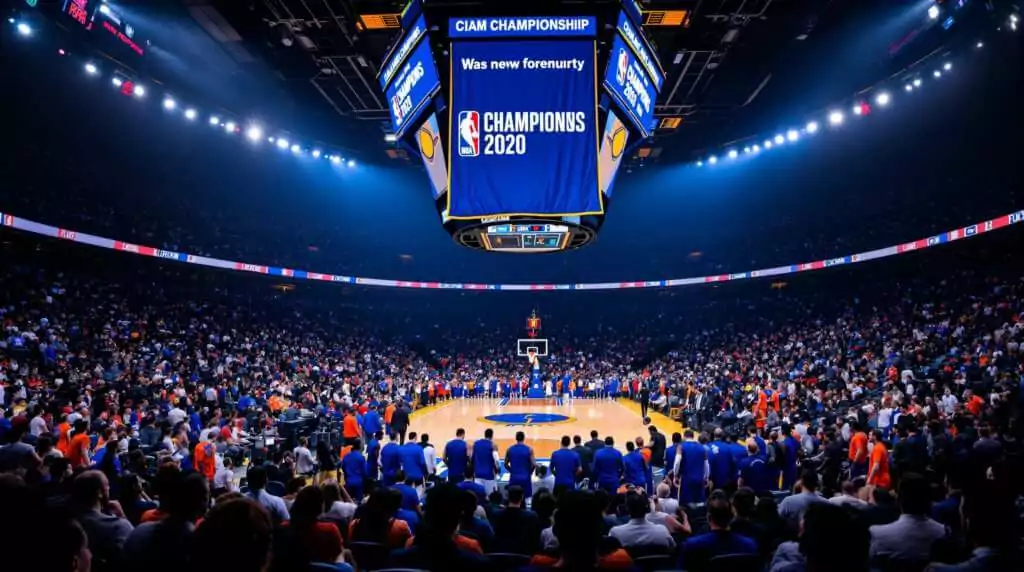
The Knicks raised their 2025–26 championship banner at Madison Square Garden before hosting Philadelphia on October 20, 2026. Demand was extraordinary. SeatGeek said its completed-transaction data showed an average secondary-market price of approximately $2,600 as of October 13, up 282% from the previous season’s opener and the highest Knicks-opener figure in its data since 2022.
The primary market also became contentious. On September 18, 2026, the Associated Press reported that MSG Sports paused individual-game sales after opening-night get-in prices exceeded $1,000. The company said prices would be reset to the prior year’s levels plus an average increase of 12%.
Those figures measure demand, not competitive strength. They do, however, show what changed after the title: a regular-season opener became a premium event priced around the banner, the opponent and expectations of another run. At roughly $2,600 per completed secondary-market transaction, nostalgia and scarcity were doing as much work as basketball analysis.
My read is measured. New York has earned contender status through the 2025 NBA Cup and 2026 championship, but a repeat can’t be presumed from those trophies. Recent history says defending champions usually fall before the conference finals, and the Knicks voluntarily accepted some roster loss to remain below a financial threshold ownership reportedly would not cross.
Knicks title defense FAQ
When did the Knicks last win the NBA championship?
The Knicks beat the Spurs 4–1 in the 2026 NBA Finals, clinching with a 94–90 Game 5 win on June 13, 2026. It was New York’s first championship since 1973 and third overall.
Who was the last NBA team to repeat as champion?
The Golden State Warriors were the last repeat champions, winning in 2017 and 2018. From 2019 through 2026, the league had eight different champions in eight seasons.
Why did Mitchell Robinson leave the Knicks?
Robinson joined Boston in July 2026 on a reported three-year, $47.4 million contract. Stefan Bondy reported that New York’s unwillingness to enter the second apron meant retaining Robinson and the entire championship bench was not feasible.
How expensive was the Knicks’ 2026 home opener?
SeatGeek reported an average completed-transaction price of approximately $2,600 on the secondary market as of October 13, 2026. MSG Sports had earlier paused individual-game sales after primary-market get-in prices exceeded $1,000.